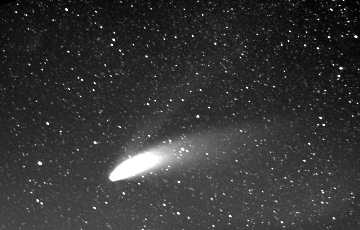
Here are some images of the Great Comet of 1997, C/1995 O1 (Hale-Bopp). The electronic images were made with a Santa Barbara Instruments Group (SBIG) ST-6 camera, which uses a 375×242 pixel CCD with pixels of 23 by 27 microns. The CCD detector is 8.6×6.5 millimetres in size. All images were made with the detector cooled to −40° C (to reduce dark current). A Nikon f/2.8 24 mm lens was used for most images (note that the angular extent of the image formed on the CCD chip is much less than the same lens would produce on 35 mm film). The camera was linked by a serial port operating at 115 Kb to a Dell Latitude XPi P133ST portable Pentium computer, using a Nanao 9070U 15 inch monitor (to allow better preview of greyscale images attached to the SVGA connector on the computer). Images were captured using SBIG's CCDOPS software, version 3.56, running in an MS-DOS window under…gag…Windows 95. The photographs were taken with a 1974 vintage Nikkormat mechanical camera (okay, it has a built-in light meter) with a variety of Nikon lenses dating from the pre-autofocus era.
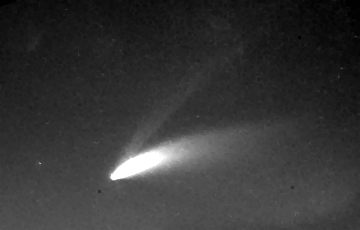
The above picture is a 30 second exposure made at 19:27 UTC on 31st March 1997; local time was 21:27 Central European Summer Time. Note the prominent appearance of both the straight plasma tail and the curved, denser dust tail. The two tails are much more evident in this comet than in 1996's Comet Hyakutake. To make the gas tail more apparent, the image below was processed by a minimum filter (which sets each pixel to the minimum of its eight neighbours and does an excellent job of turning off the stars). The image was then slightly brightened and contrast enhanced to improve the visibility of the tails.
The plasma tail, consisting primarily of CO+ and CO2+ ions, but also containing ions of other common compounds of carbon, hydrogen, oxygen, and nitrogen, emits primarily in the blue. This is a composite of three exposures taken through red, green, and blue filters which shows the distinctive blue cast of the plasma tail. (The red streak was due to the passage of a satellite across the tail of the comet during the 30 second red filter exposure.) These images were taken within a 5 minute period around 20:30 UTC on 1st April 1997.
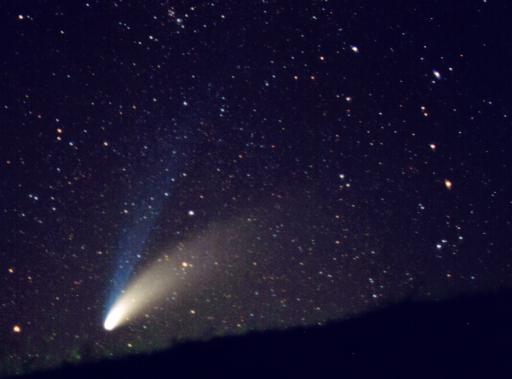
The plasma tail is easily captured by conventional photography. The image below is a 45 second exposure (note the slight star trails near the edge since it was unguided) on Kodak 400 speed “Gold” colour print film taken at approximately 20:30 UTC on 31st March 1997 through a Nikon f/1.4 50 mm lens. The comet wasn't anywhere near as close to the horizon as this picture suggests; the picture was shot from a roadcut in order to block light from a streetlight which would have otherwise spoiled the image due to blooming and internal reflection in the lens. The slight green tinge at the apparent horizon comes from out-of-focus blades of grass illuminated by the offending streetlight.
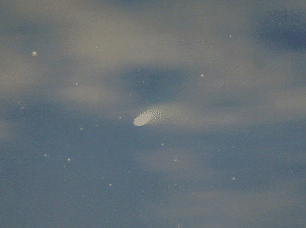
The extraordinary brilliance of this comet rendered it easily visible in viewing conditions which would have completely obliterated most comets. The following picture shows the comet shining through a thin cloud deck before the end of twilight. Now, no astronomer ever hopes for clouds or anything but the darkest sky, and much of the detail was washed out under these conditions, but after years of searching for barely-there faint smudges of light through telescopes, this was an astonishing naked-eye sight. This picture was taken on 30th April 1997 and looks just like the print—no image enhancement has been done to make the comet more apparent.
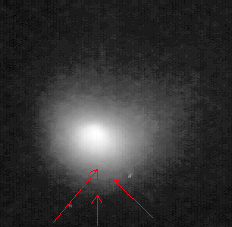
Viewed through telescopes of modest aperture (I used apochromatic refractors of 80 and 150 mm), the most striking feature of the comet's head was the clearly-defined shells of emission. These are the result of the emissions from the nucleus being confined to isolated venting points and the rotation of the nucleus; the rate of rotation of the nucleus can be inferred from the spacing of these shells and knowledge of how fast the material comprising them propagates through the solar radiation pressure and wind environment in which the comet finds itself. The following picture is the best I've been able to produce so far to represent the visual appearance of these shells. The visual effect, at least through a 150 mm aperture f/6 Astro-Physics refractor with a 12 mm focal length eyepiece is far more striking than this picture, taken on 1st April 1997 at approximately 22:00 UTC on Kodak Gold 400 film with a Nikon 300 mm f/4.5 telephoto lens. I've added arrows to point out the shell boundaries. In this image, the shells are somewhat subtle and resemble their visual appearance through the VernonScope 80 mm refractor. With the 150 mm telescope, the shells are unambiguous and resemble drawings of Comet Donati (1858 VI), which I always assumed were “enhanced” in the charcoal sketches made by G. P. Bond in October of 1858.
Long after photography supplanted visual observation in professional astronomy, astronomers still often resorted to charcoal sketches to describe the appearance of comets. By accumulating light during a long exposure, photography permits, for a given telescope aperture, observation of objects much fainter than the human eye can perceive. But, since it functions in a fundamentally different way than the eye, photography is limited in its ability to reproduce the visual appearance of an object. Electronic sensors, combined with computer image processing, can help bridge that gap.
Ignoring some subtleties irrelevant to this discussion, photographic film is more or less linear in its response to light. A spot on a negative starts out transparent and darkens as photons strike it; a spot hit by twice the number of photons will be twice as dark. Unfortunately, this process has limited dynamic range: the negative darkens due to irreversible chemical reactions triggered by photons, and once all the molecules have reacted, additional photons cause no further change; that area on the film is said to have been saturated. Negative film and transparencies have a small dynamic range compared to the human eye, and photographic print paper is even more severely limited.
An object like a comet has a tremendous intensity range; as we've seen above, its nucleus may be bright enough to glimpse through clouds soon after sunset, but to see the full extent of the tail may require the darkest and most pellucid sky an astronomer can dream of. This range of brightness exceeds, by far, the dynamic range of photographic film and paper, forcing the photographer to choose between emphasising detail in the bright comet head and sacrificing most of the tail, or showing the full extent of the tail but having the head turn into an overexposed featureless blob. Without resorting to darkroom tricks, it just isn't possible to make a photograph of a comet that realistically portrays its visual appearance. For example, if I want to show the small, very bright ball of gas and dust near the nucleus, I have to use an exposure that results in a picture like the one below.
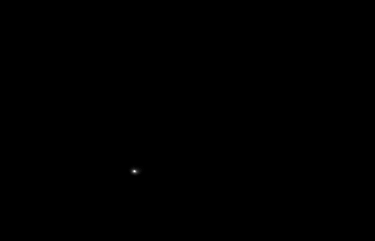
While the nucleus comes out just fine, all the detail of the coma and tail is missing. If I expose, as in the next image, to capture as much as possible of the tail, no hint of the bright nucleus appears in the overexposed head.
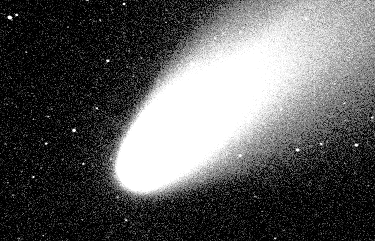
Yet, when you observe the comet visually, you have no difficulty seeing all the detail at once. Why is this? The reason is that unlike the linear response of photographic film to light, the eye's response is approximately logarithmic, which allows you to simultaneously perceive a much wider dynamic range of intensity. Electronic imaging allows approximating human perception much more closely. Most electronic sensors are, like photographic film, linear, but their dynamic range is often so much greater compared to film they can accommodate the full intensity range of an object being imaged. The two views of the head of the comet above were, in fact, produced from the very same CCD image (through the Nikon 300 mm f/4.5 lens); the first processed to show only the brightest regions, the second showing the faintest detail. While most computer screens can show only 256 or fewer levels of grey, the CCD camera used to capture this image can distinguish on the order of 65,636 distinct light intensities (actually fewer due to noise and statistical effects, but still many, many times greater than film).
This means that a CCD image may contain more information than a cursory glance reveals. Image processing can tease out latent images impossible to capture on conventional film. If the response of the human eye is logarithmic, then suppose we simply replace each pixel in the image with a pixel whose intensity is the logarithm of the original pixel. In fact, this results in an image strikingly similar to the appearance of the comet's head to the human eye.
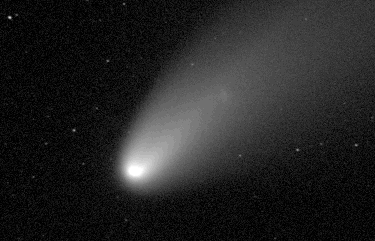
Having the image in digital form makes it easy to prepare false colour renderings in which different intensities are represented by colour. The eye is far more sensitive to changes in colour than slow gradations of intensity, so such renderings may reveal detail difficult to notice in a grey scale image. In each of the images below the scale at the bottom shows the colour palette assigned to intensities with the minimum at left and the maximum at right.
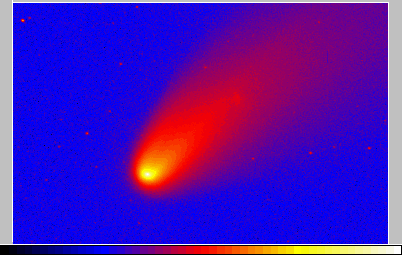
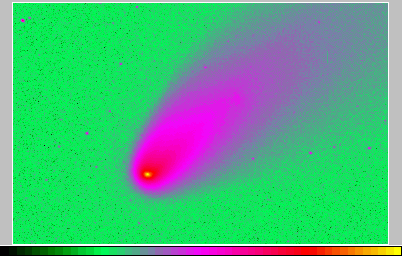
Image processing and false colour rendering for this section was done with the Smithsonian Astrophysical Observatory's saoimage package, running on a Silicon Graphics Indigo² workstation.
A stereo image of the comet on the day its closest approach to the Sun is available, courtesy of Solar System Live, using orbital elements published in Minor Planet Electronic Circular 29067. An ephemeris for the prominent apparition of the comet, as given in IAU Circular 6547 of 27th January 1997. If you are interested in this kind of fast-breaking astronomical information, you can obtain your own subscription to the Circulars.
COMET C/1995 O1 (HALE-BOPP)

1997 TT     R. A. (2000) Decl.     Delta      r    Elong. Phase      m1
Feb. 11    20 07.85    +20 50.1    1.807    1.251   41.4   31.5      0.3
     16    20 24.40    +23 57.3    1.711    1.196   43.0   34.3     -0.1
     21    20 43.63    +27 22.0    1.620    1.144   44.3   37.1     -0.4
     26    21 06.32    +31 01.2    1.535    1.095   45.3   40.0     -0.7
Mar.  3    21 33.42    +34 48.4    1.460    1.050   46.0   42.7     -1.0
      8    22 05.97    +38 31.4    1.398    1.010   46.2   45.2     -1.2
     13    22 44.77    +41 51.1    1.352    0.976   46.1   47.2     -1.5
     18    23 29.71    +44 22.6    1.323    0.948   45.6   48.6     -1.6
     23     0 19.05    +45 42.1    1.315    0.929   44.8   49.1     -1.7
     28     1 09.30    +45 36.5    1.327    0.917   43.7   48.7     -1.8
Apr.  2     1 56.54    +44 10.4    1.359    0.914   42.3   47.4     -1.7
      7     2 38.11    +41 42.9    1.406    0.920   40.7   45.2     -1.6
     12     3 13.22    +38 38.1    1.468    0.935   39.0   42.5     -1.5
     17     3 42.36    +35 16.3    1.540    0.957   37.2   39.4     -1.3
     22     4 06.55    +31 51.7    1.619    0.987   35.3   36.0     -1.0
     27     4 26.85    +28 32.7    1.702    1.023   33.3   32.7     -0.7
May   2     4 44.15    +25 23.3    1.787    1.065   31.4   29.5     -0.5
      7     4 59.16    +22 25.2    1.873    1.111   29.4   26.5     -0.2
     12     5 12.42    +19 38.4    1.958    1.161   27.6   23.8      0.1
     17     5 24.31    +17 02.1    2.041    1.215   25.9   21.3      0.4
     22     5 35.14    +14 35.2    2.121    1.271   24.4   19.2      0.7
     27     5 45.12    +12 16.5    2.199    1.329   23.2   17.5      0.9
June  1     5 54.43    +10 04.8    2.272    1.388   22.3   16.1      1.2
This document and all the images it contains are in the public domain and can be used in any way you wish without any restrictions whatsoever.by John Walker